The genesis edition. Full weekly cadence begins with Issue #1.
For most, industrial automation is a volume game — more deployment, more capital, more noise. In Issue #0, we begin our mandate to curate the silence. Beneath the record $18.8B venture frenzy and the premature obituaries of the human assembly line lies a tectonic shift in the architecture of production. We do not track the spectacle; we isolate the anomalies — the throttled pilot programs, the phantom backlogs, the unpriced regulatory risks — that dictate whether an enterprise survives its own scaling.
The Tape
Week ending Thursday, July 2 (US markets closed Friday, July 3 for the holiday). End-of-day data via Stooq.
| 1-week | 4-week | |
|---|---|---|
| BOTZ (robotics & AI) | +3.83% | −1.55% |
| SPY (S&P 500) | +2.17% | +0.98% |
| ROBO (robotics & automation) | +1.70% | +0.01% |
| SNSR (industrial IoT) | +1.56% | −2.19% |
| XLI (industrials) | +1.50% | +5.59% |
| ROK (Rockwell Automation) | −1.07% | +5.59% |
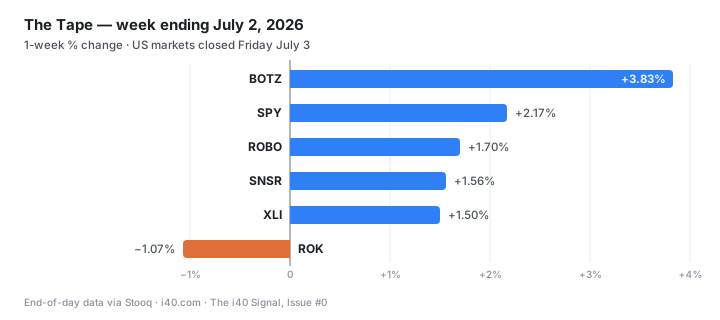
The shape of the week: the purest robotics speculation (BOTZ) led the tape while the only legacy-automation single name in our universe (Rockwell) was the lone decliner — yet over four weeks the picture inverts, with the industrial base (XLI +5.59%) far ahead of every robotics vehicle. Macro texture underneath: industrial production essentially flat in May (+0.05%), core capital-goods orders up +1.42%, manufacturing employment +3k in June. The market is not paying for current production. It is paying for what replaces it.
Flow & Funding
Salvatore Chen
Robotics venture funding hit $18.8B globally in 2026 through June 22 — against $15.0B for all of 2025 (Crunchbase). The capital wave "is acting like a turbine spinning at high velocity while the clutch is still disengaged. The market is attempting to price in a future that the supply chain hasn't finished building."
The week's structural read on the humanoid wave:
- Contracted reality: Agility Robotics is going public via a $2.5B pre-money SPAC with >$300M in contracted multi-year Digit v5 orders and active deployments at Schaeffler, GXO, and Toyota Motor Manufacturing Canada. "That is the low-thrumming truth of industrial reality. They are surviving the friction of actual logistics floors."
- Claimed reality: Ant Group led a ~$73.6M pre-Series A in Zeroth, an eldercare-humanoid startup claiming a 30,000+ unit backlog. "A pre-Series A company claiming a 30,000-unit backlog is a statistical ghost… likely non-binding letters of intent designed to inflate the round."
- The quiet signal: Luxonis raised $14M for embedded vision ("the perception layer behind physical AI") and Mowito raised $3M to teach industrial arms tasks from demonstration. "Before a humanoid can sequence logistics natively, the perception and demonstration-learning layers must be perfected. The smart capital is funding the nervous system, while the speculative capital is buying the skin."
On the Floor
Salvatore Chen
The BMW numbers, run honestly. BMW will deploy Figure 03 humanoids at Plant Spartanburg after an 11-month Figure 02 pilot the company says supported 30,000+ X3s, logged 1,250+ runtime hours, and handled 90,000+ parts. Apply unit-economics logic to what was handed to us: a manufacturing cell on a standard two-shift operation logs roughly 3,500–4,000 hours over eleven months; Figure 02 was active for 1,250. And 90,000 parts across 1,250 hours is 72 parts per hour — a little over one part per minute. "That is not high-velocity manufacturing; that is an adoption bottleneck in real time." The pilot proves uptime and spatial integration — a necessary first step — and the move to logistics sequencing is the honest tell: humanoids find their first real footing in lower-velocity, higher-variability work, not line-rate assembly.
Demo-ware vs. downtime. Rockwell and Cisco's software-defined-manufacturing launch in India is, for now, a reference design and "a demo pod in Gurugram… a controlled environment, free from the chaotic dust and legacy protocol clashes of a 40-year-old stamping plant." The plant-floor priority hides in the far less glamorous Siemens–IFS partnership targeting unplanned downtime by closing the loop between MES and asset management — "exactly what operations directors are begging for."
The anchor of reality. Honeywell completed its three-way split on June 29; the remaining Honeywell Technologies is now a pure-play automation company — whose recast Industrial Automation segment did $1,423M in Q1 sales, down 11% year-over-year (unaudited 8-K exhibit). You can't out-innovate a flat industrial-production tape.